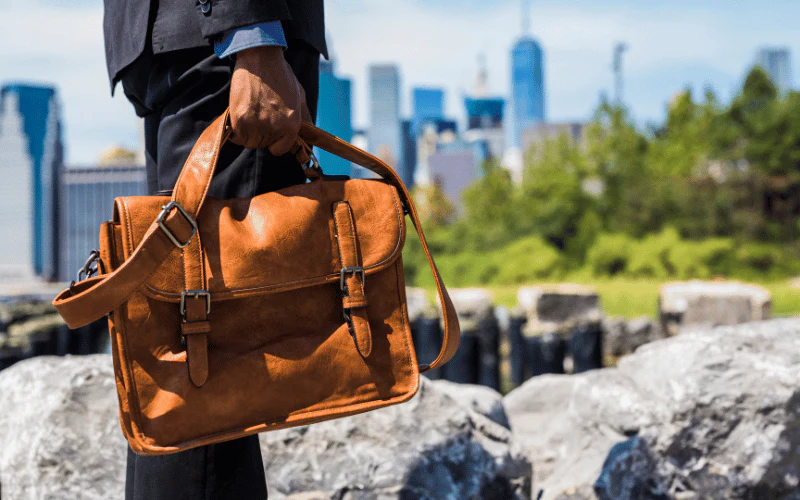
A handmade leather satchel bag is a carry bag produced through artisan craft techniques – including hand-cutting leather panels from full-grain hides, saddle-stitch construction using two needles and waxed thread, hand-burnished edge finishing, and hand-applied surface treatment – rather than factory machine production. Handmade leather satchels are worth more than machine-made equivalents because the construction methods produce a fundamentally more durable bag that improves in character with use, rather than a bag that is assembled efficiently at the cost of long-term quality.
The word handmade has been so thoroughly absorbed by marketing language that it has nearly lost its meaning. Products described as handmade range from genuinely artisan-crafted bags produced by skilled craftsmen through multi-generational leather traditions to bags where a human being briefly touches a machine-made component during the packaging process.
The distinction matters because the construction methods in genuine handmade leather work produce specific, verifiable quality differences – particularly in stitch durability, edge finishing, and the fit and integrity of the assembled panels. These are not aesthetic differences. They are functional differences that determine how long the bag lasts and how it behaves under daily professional use.
Rustic Town’s handmade leather satchel bags are produced by artisan craftsmen in Rajasthan, India – through a leather tradition with centuries of documented practice.
What Construction Techniques Define a Genuinely Handmade Leather Satchel?
| Technique | Handmade Standard | Machine Production Standard | Functional Difference |
| Panel cutting | Hand-cut from full-grain hide sections | Die-cut in batch from standardised sheets | Hand-cut selects the best grain; die-cut is uniform regardless |
| Stitching | Saddle stitch – two needles, locked at each point | Machine interlocking stitch – single thread loop | Saddle stitch holds at thread failure; machine stitch unravels |
| Edge finishing | Hand-burnished – compressed by friction and heat | Painted with edge coat or left raw | Burnished never peels; painted edges peel within 2 years |
| Hardware attachment | Hand-set through reinforced leather backing | Machine-pressed through thin panel | Hand-set attachment is stronger at stress points |
| Surface treatment | Hand-applied antiquing, wax, or conditioning | Machine-sprayed coating | Hand treatment is absorbed into the leather; sprayed is surface only |
Saddle stitching is the most functionally significant of these techniques for long-term durability. In machine-stitched leather goods, the interlocking thread loops mean that when one thread breaks – which happens over years of mechanical stress – the seam unravels progressively from the break point. In saddle-stitch construction, each stitch point is independently locked: a single thread failure holds at that point and does not affect adjacent stitches. A saddle-stitched seam on a daily carry bag lasts the lifetime of the leather.
What Is the Rajasthan Leather Craft Tradition Behind Rustic Town’s Satchels?
Rajasthan, in northwestern India, is the traditional centre of Indian leather tanning and artisan leather goods production. The craft tradition in the region dates to the medieval period, with specific craft families and communities developing specialised techniques in tanning, dyeing, saddle-making, and bag construction that have been refined through generations of practice.
The vegetable tanning tradition.
Rajasthan tanneries have maintained the slow, traditional vegetable tanning process – using plant-based tannins from bark, fruit, and leaves – as opposed to the faster chrome tanning process dominant in industrial leather production. Vegetable tanning produces firmer, more natural leather with better patina development and longer structural life.
Buffalo leather specialisation.
The region’s artisan leather workers have specific, deep expertise in working with buffalo hide – characteristically thicker and denser than cowhide and requiring different cutting, stitching, and finishing techniques. This specialisation is the reason buffalo leather goods from Rajasthan craftsmen represent a quality standard that industrial buffalo leather production cannot match.
Multi-generational craft transmission.
The techniques – saddle stitch, edge burnishing, pattern cutting, hardware setting – are transmitted through apprenticeship within craft families and communities. The institutional knowledge embedded in a craftsman who has worked leather for 20 years under a master who worked it for 30 years before them is not replicable in a factory training programme.
How Do You Identify a Genuinely Handmade Leather Satchel?
Examine the stitch lines.
Saddle-stitch lines have a slightly diagonal, hand-driven appearance – each stitch is slightly individual while maintaining consistent spacing. Machine stitching is perfectly uniform and perfectly vertical. The slight variation of a hand-stitched seam is not imprecision – it is the signature of the technique.
Check the cut edges.
Hand-burnished edges are smooth, hard, and sealed – the leather fibres are compressed into a unified surface. Run a fingernail along the edge: burnished edges do not flake. Painted edges have a slightly different texture and will eventually flake when the edge coat dries and chips.
Feel the panel thickness.
Hand-cut panels from full-grain buffalo hide have a consistent, substantial thickness across the bag surface. Machine-cut panels from thinner or split hide have a lighter, less dense feel that is tangible in comparison.
Look for natural surface variation.
A hand-selected full-grain leather panel will have the natural grain variation of the original hide. A machine-processed lower-grade panel will have uniform, artificial-looking grain – consistent across the entire surface because the original grain has been corrected.
What Does a Handmade Leather Satchel Cost and Is the Premium Justified?
| Price Range | What You Get | Production Method | Long-Term Value |
| Under $40 | Synthetic or genuine leather at best | Factory machine production | Poor – replace within 2-3 years |
| $40-$60 | Top-grain or entry full-grain | Mixed machine + some hand finishing | Good – holds for 5-8 years with care |
| $60-$100 | Full-grain, partial artisan construction | Semi-artisan, hand finishing at key points | Very good – lasts 10-15 years |
| $100-$150 | Full-grain buffalo, full artisan construction | Artisan saddle-stitch throughout | Excellent – lasts 15-20+ years, improves |
| $150+ | Premium full-grain, select construction | Full artisan, premium hardware finish | Exceptional – generational carry |
The honest price range for a fully artisan-constructed handmade leather satchel from Rajasthan craftsmen is $50-$150. Rustic Town’s range falls within this band for precisely the reason outlined above: direct artisan sourcing removes the wholesale and retail margins that inflate the same material quality to $300-$500 at heritage brand retail.
Frequently Asked Questions: Handmade Leather Satchel Bags
Q: What makes a leather satchel bag genuinely handmade?
A: Saddle-stitch construction using two needles and waxed thread, hand-cut full-grain leather panels, hand-burnished edge finishing, and hand-set hardware – produced by artisan craftsmen with specific material expertise rather than factory machine assembly.
Q: Is saddle stitching stronger than machine stitching in leather bags?
A: Yes – saddle stitching locks each stitch point independently, so a single thread failure does not cause seam unravelling. Machine interlocking stitching can unravel progressively from a single break point. Saddle-stitched seams on quality leather last the lifetime of the bag.
Q: Where are Rustic Town handmade leather satchels made?
A: Artisan workshops in Rajasthan, India – a region with centuries of established leather craft tradition, specialising in full-grain buffalo leather and vegetable tanning methods.
Q: How do I tell if a leather satchel is genuinely handmade?
A: Examine the stitch lines for the slight individual variation of hand-driven saddle stitch. Check cut edges for the smooth, hard feel of burnishing versus the slight tackiness of painted edge coat. Feel the panel density – full-grain is substantially heavier and denser than lower grades.
Q: Are handmade leather satchels worth the higher cost?
A: Over a 10-15 year ownership period, yes. A handmade full-grain leather satchel at $89.99-$129.99 lasts significantly longer than multiple machine-made alternatives at equivalent price intervals and develops a character that factory production cannot replicate.
Q: What is vegetable tanning and why does it matter in a handmade satchel?
A: Vegetable tanning uses plant-based tannins to cure the hide – a slower, traditional process that produces firmer leather with better patina development and longer structural life than industrial chrome tanning. Rustic Town uses vegetable-tanned full-grain buffalo leather throughout its artisan satchel range.
Q: Can machine-made leather satchels match the quality of handmade ones?
A: At the construction level, no. Saddle stitching, hand-burnished edges, and hand-selected panel cutting produce measurably better long-term construction quality than machine equivalents. High-end machine production can approach but not equal artisan handmade standards.
Explore Rustic Town’s range of handmade leather satchel bags – artisan-crafted in Rajasthan, saddle-stitched, from $49.99.